
Industry insight
Why ISPs Are Merging: Inside the Broadband Consolidation Wave
Discover why ISPs across North America are merging as rising costs, funding programs, and technology shifts drive a new wave of broadband consolidation.
Georgette Lopez-Aguado, VP, Client Experience
November 5, 2025 · 5 MIN · UPD JUN 16, 2026
ISPs are merging because rising fiber network costs, tighter margins, and funding programs like and Canada's Universal Broadband Fund have made scale a requirement for survival. Consolidation lets operators spread fixed costs, qualify for grants, and run operations more efficiently.
Across North America, the broadband industry is experiencing one of its most significant shifts in decades. What began as regional fiber rollups has evolved into a full-scale wave of mergers, acquisitions, and partnerships reshaping how internet service providers (ISPs) compete, scale, and operate.
For many small and mid-sized operators, the equation has changed. Rising network costs, tighter margins, and evolving funding programs have made scale a requirement for survival. Growth now depends not just on expansion but on integration, bringing networks, systems, and teams together to deliver broadband more efficiently.
The Broadband M&A Landscape in the U.S. and Canada
In the United States, deal activity in telecom infrastructure has surged. According to ION Analytics, North American telecom transactions reached roughly US $81 billion in 2024, more than double the total from the previous year. An AlixPartners survey found that 80% of U.S. fiber operators expect M&A activity to increase in 2025, with most targeting smaller regional networks.
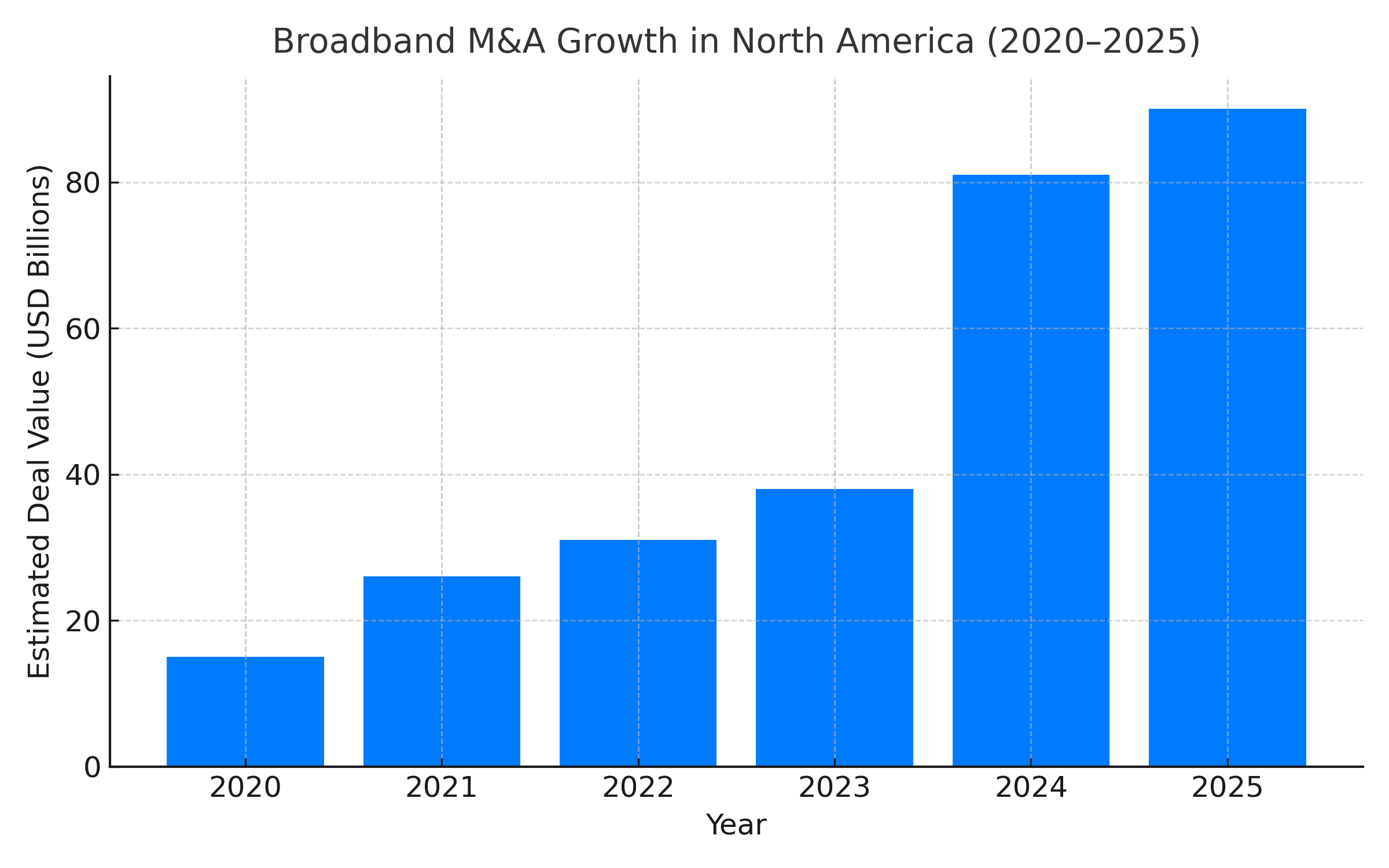
In Canada, the momentum is also strong, though shaped by different regulatory and geographic factors. The Universal Broadband Fund (UBF), a C$3.225 billion initiative, aims to connect 98% of Canadians to high-speed internet by 2026. The program has encouraged collaboration between federal and provincial governments, municipalities, and private ISPs, leading to partnerships and mergers to achieve nationwide coverage targets.
Canada's M&A scene includes large national transactions and regional consolidations. The Rogers - Shaw merger, completed in 2023, combined two of the country's biggest telecoms. More recently, Bell Canada's acquisition of Ziply Fiber for about US $5 billion extended Bell's fiber footprint into the U.S. Pacific Northwest, creating one of the first major cross-border broadband acquisitions.
These examples highlight that broadband consolidation is not only a U.S. phenomenon but a North American one, driven by shared economic and operational realities.
Why Broadband Consolidation Is Accelerating
Rising Fiber Costs and Competitive Pressure
Building and maintaining fiber networks is expensive. Construction costs, equipment pricing, and labor expenses have climbed steadily. For smaller ISPs, those costs are difficult to absorb alone. Merging with nearby operators or joining a larger platform helps spread fixed costs, access better procurement terms, and streamline field operations.
Competition has also intensified. Cable companies are investing in 4.0, while wireless carriers are expanding Fixed Wireless Access (FWA) coverage across rural and suburban regions. A recent AlixPartners study found that nearly half of U.S. fiber providers view FWA as a direct competitive threat.
In Canada, the broadband market is heavily concentrated, with Bell, Rogers, and TELUS controlling more than 90% of subscribers. Smaller ISPs are merging or partnering to gain scale, share infrastructure, and strengthen their ability to compete.
How BEAD and UBF Funding Favor Scale
Government funding programs are another key driver. In the U.S., the Broadband Equity, Access, and Deployment (BEAD) program and the Rural Digital Opportunity Fund (RDOF) are directing tens of billions of dollars toward broadband expansion, but the qualification process favors financially stable operators with the resources to meet compliance and reporting requirements.
Similarly, Canada's Universal Broadband Fund and provincial connectivity initiatives reward ISPs that can manage large-scale buildouts and maintain rigorous performance tracking. Scale and reliability are now prerequisites for funding, not nice-to-haves.
In both countries, consolidation often becomes the fastest path to eligibility. Operators with unified back-office systems, automated reporting, and proven deployment records are far better positioned to secure public funding and deliver on grant obligations.

The Operational Efficiency Advantage
Consolidation is ultimately about efficiency. When ISPs combine systems, teams, and service territories, they unlock the ability to centralize network operations centers, standardize billing and provisioning workflows, and eliminate redundant tools and processes.
As KPMG notes, infrastructure M&A will remain strong through 2026 because standardized operators deliver better margins and more predictable cash flow. CoBank also reports that ISPs combining wireless and fiber capabilities are best positioned for the next phase of growth as customers seek converged connectivity solutions.
How Canada's Policy Shifts Are Reshaping the Market
In August 2024, the CRTC expanded wholesale access rules to require national carriers to share fiber infrastructure with competitors starting in 2025. The policy is intended to stimulate competition but also increases complexity for network operators.
For smaller ISPs, this could mean new opportunities to reach customers through shared access. For larger carriers, it creates an incentive to consolidate smaller networks before the new framework takes effect. Combined with the UBF's nationwide rollout targets, these policy changes are accelerating M&A discussions across provinces.
A Broadband Market Built on Integration
From the rural Midwest to northern Ontario, the broadband story is increasingly one of integration. Every merger or partnership is about more than adding subscribers; it is about simplifying operations, creating efficiency, and unlocking economies of scale.
The North American broadband market is maturing into an interconnected ecosystem where infrastructure and operations must align seamlessly. ISPs that can integrate systems quickly and standardize their processes are turning consolidation into a catalyst for growth instead of disruption.
How Sonar Helps ISPs Navigate M&A
At Sonar, we've helped many ISPs across North America successfully navigate the complexities of mergers and acquisitions. Whether expanding into new territories, integrating acquired networks, or preparing for sale, Sonar's /BSS platform is purpose-built for operational readiness, unifying billing, provisioning, and subscriber management across combined networks.
Sonar's flexible architecture and onboarding experts help ISPs move from complex integrations to stable, scalable operations faster.
If your organization is exploring a merger, acquisition, or partnership, our team can help assess your readiness and design a smooth, data-driven transition. Schedule a demo
Frequently asked questions
Why are ISPs merging right now?
Rising fiber construction and labor costs, intense competition from DOCSIS 4.0 cable and Fixed Wireless Access, and funding programs that favor financially stable operators have made scale essential. Merging spreads fixed costs and improves eligibility for public funding.
How do funding programs like BEAD and UBF encourage consolidation?
Programs such as BEAD, RDOF, and Canada's Universal Broadband Fund direct billions toward broadband expansion but reward operators that can meet strict compliance, reporting, and large-scale buildout requirements. Consolidation often becomes the fastest path to qualifying.
How should an ISP prepare its operations for an acquisition?
ISPs that succeed in M&A have unified back-office systems, automated reporting, and proven deployment records. Standardizing billing, provisioning, and subscriber management before integration makes the transition smoother and faster.
Questions, answered.
Why are more ISPs merging in North America?
Rising costs, funding programs, and technology shifts are driving a new wave of broadband consolidation across North America. North American telecom transactions reached roughly US $81 billion in 2024, more than double the prior year's total.
How do BEAD, RDOF, and Canada's Universal Broadband Fund favor larger ISPs?
These funding programs favor financially stable ISPs that can meet compliance and reporting requirements. That makes scale a prerequisite for funding, pushing smaller operators to merge or partner.
Is broadband M&A activity expected to keep increasing?
Yes. 80% of U.S. fiber operators expect M&A activity to increase in 2025, with deals mostly targeting smaller regional networks.
What operational benefits do ISPs gain from consolidation?
Consolidation lets ISPs centralize network operations centers, standardize billing and provisioning, and eliminate redundant tools. In Canada, where Bell, Rogers, and TELUS control more than 90% of broadband subscribers, smaller ISPs often merge or partner to reach that kind of scale.
See it on the platform
20 minutes wired to your operation.
An ISP-only specialist walks Sonar through your specific use case. No generic deck, no horizontal SaaS pitch.
Book a meetingWritten by
Georgette Lopez-AguadoVP, Client Experience
Georgette Lopez-Aguado leads Client Experience at Sonar Software and co-founded Women of WISPA. She writes on customer experience, BEAD funding, and the broadband industry from nearly a decade in OSS and BSS.
All posts by Georgette Lopez-Aguado