Industry insight
How ISPs Can Optimize Marketing Budgets and Maximize ROI During Inflation
Discover how precision marketing can transform your ISP's marketing. Learn how to target with accuracy and eliminate wasted expenses.
Taneil Currie, Former Senior Manager, Growth Marketing
May 29, 2023 · 4 MIN · UPD JUN 16, 2026
To optimize an ISP marketing budget during inflation, stop trying to control external costs and start accurately tracking cost per lead (CPL) and cost per sale (CPS) by campaign, then capture data at the most granular level possible to make data-driven targeting decisions. That shift, from cost control to measurement, is what protects ROI when budgets tighten.
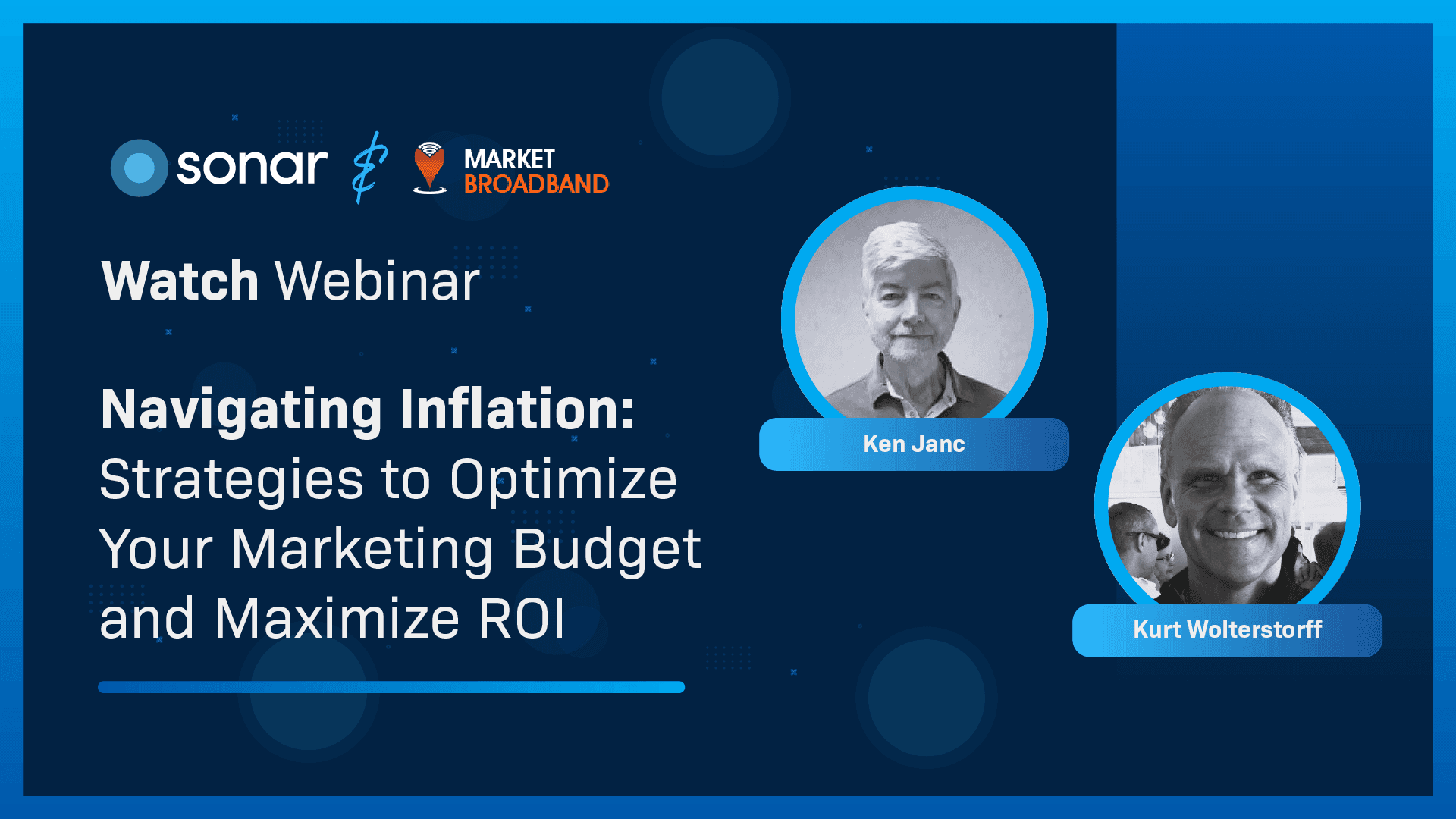
We recently co-hosted a webinar with industry marketing experts Ken Janc and Kurt Wolterstorff of Marketbroadband, who shared strategies to optimize marketing budgets and maximize ROI amidst inflationary challenges.
Inflationary pressures and the changing landscape brought about by the Covid-19 pandemic have presented significant challenges for internet service providers. Rising equipment, material, and transportation costs, coupled with increased competition for paid search ads and changes in privacy policies, have impacted marketing budgets and effectiveness.
Watch the webinar replay 👇
Why cost control is the wrong focus for ISP marketing
The webinar highlighted that the real problem lies beyond cost control measures such as equipment, postage, paper, and PPC ads. Instead, the focus should be on accurately tracking and measuring the cost per lead (CPL) and cost per sale (CPS) by campaign. By understanding the data and levers that drive marketing success, businesses can make informed decisions to optimize targeting, offers, creative elements, and delivery vehicles.
Two examples were discussed to illustrate effective tracking and measurement methods. In the case of direct mail campaigns, incorporating unique tracking numbers, promo codes, and campaign-specific landing pages can encourage prospects to engage with the campaign. However, it's important to recognize that prospects often follow their own path of engagement, making it crucial to capture and analyze data beyond the initially intended actions.
On the other hand, Facebook campaigns present attribution challenges due to limited address-level targeting. While metrics such as impressions, clicks, and engagement are available, it becomes difficult to measure exact attribution without a comprehensive view of the customer journey. Relying on hope as a strategy is not sustainable, and businesses need to explore better ways to track and measure campaign success.
Capture lead and sales data at the most granular level
To overcome these challenges, businesses must identify the tools and methods available for capturing lead and sales data. Capturing data at the most granular level possible, whether it be address level, zipcode level, or anonymous site visits, is crucial. By implementing a system to capture and analyze data, businesses can gain valuable insights into their campaigns' success and make data-driven optimization decisions.
Defining success metrics and planning for attribution are also essential before launching a campaign. Understanding the lifetime value of a new customer and establishing break-even points can guide investment decisions. By aligning the marketing strategy with revenue goals and customer retention, businesses can finance growth and avoid a downward spiral.
Two targeted programs: win-backs and neighbor targeting
The webinar also highlighted two takeaway programs. The first program focused on win-back strategies, targeting both movers and disgruntled customers. By identifying the reasons for customer dissatisfaction and addressing them through competitive offers, improved services, and effective communication, businesses can turn unhappy customers into loyal advocates and reduce churn.
The second program suggested targeting the neighbors of new subscribers who have switched from a competitor. By offering enticing incentives and proximity-based messaging, businesses can tap into pockets of vulnerability for the other ISP and capture a significant portion of the market share from dissatisfied customers in the immediate vicinity.
In conclusion, the webinar emphasized that inflation, increased competition, and changing privacy policies have posed challenges for ISP's. However, by shifting the focus from controlling external costs to tracking and measuring campaign effectiveness, businesses can gain better control over their marketing efforts. By capturing and analyzing data, defining success metrics, and implementing targeted programs, ISP's can navigate these challenges and thrive in an evolving market.
Unleash the power of precision marketing with Marketbroadband
In the highly competitive broadband market, ISPs have often faced a dilemma between over-marketing to reach all potential subscribers or under-marketing to control their budget. This has led to wasted marketing dollars spent or missed opportunities, both of which are undesirable outcomes.
Fortunately, MarketBroadband offers a solution to this problem. Their GIS Marketing Platform empowers ISPs to target their marketing efforts exclusively within their network, down to the address level. Giving ISPs complete control over the message and recipients.
With MarketBroadband, ISP's can target direct mail and digital display ads with precision, ensuring they reach only the intended audience within their service area.
Visit their website to learn more about how MarketBroadband can revolutionize your ISP marketing.
Frequently asked questions
What metrics should ISPs track to optimize marketing during inflation?
Rather than focusing only on external costs like postage, paper, and PPC ads, ISPs should accurately track and measure cost per lead (CPL) and cost per sale (CPS) by campaign, then capture lead and sales data at the most granular level possible to guide targeting and budget decisions.
How can ISPs win back lost or unhappy subscribers?
Win-back programs target both movers and disgruntled customers. By identifying the reasons behind dissatisfaction and responding with competitive offers, improved services, and clear communication, ISPs can turn unhappy customers into loyal advocates.
What is precision marketing for broadband providers?
Precision marketing lets ISPs target direct mail and digital display ads exclusively within their network footprint, down to the address level, so they reach only the intended audience in their service area and eliminate wasted spend.
Questions, answered.
How can ISPs optimize their marketing budgets during inflation?
The real problem in ISP marketing is not external cost control but accurately tracking cost per lead and cost per sale by campaign. Capturing lead and sales data at the most granular level possible, from the address level to anonymous site visits, drives better optimization decisions.
Why should ISPs track cost per lead and cost per sale by campaign?
Tracking cost per lead and cost per sale by campaign is the real lever in ISP marketing, more than trying to control external costs. Defining success metrics and planning attribution before launching a campaign helps align spend with customer lifetime value and break-even points.
What is precision marketing for broadband providers?
Precision marketing means targeting with accuracy and eliminating wasted expenses rather than spending broadly. It relies on capturing lead and sales data at the most granular level possible, from the address level to anonymous site visits, so providers can make better optimization decisions.
How can ISPs win back movers and disgruntled customers?
Win-back programs that target movers and disgruntled customers can convert unhappy subscribers into loyal advocates. Targeting the neighbors of new subscribers who switched from a competitor also lets ISPs capture market share from pockets of churn vulnerability.
See it on the platform
20 minutes wired to your operation.
An ISP-only specialist walks Sonar through your specific use case. No generic deck, no horizontal SaaS pitch.
Book a meeting