Funding & Compliance
BEAD Funding Alternatives for Fiber Operators Who Missed Out
Missed out on BEAD? Discover fast, scalable alternatives for fiber operators - from ReConnect to private capital - and how Sonar streamlines delivery.
Madeline Hanna, Customer Marketing Manager
September 11, 2025 · 4 MIN · UPD JUN 16, 2026
Missed out on ? Fiber operators still have fast, viable funding paths, including USDA ReConnect, state Universal Service Funds, public-private partnerships, and private capital, and pairing them with a scalable operational stack keeps expansion plans alive.
When BEAD was first announced, many fiber operators saw it as the golden ticket for rural broadband builds. But with recent changes - technology-neutral rules, stricter scoring, and fewer eligible areas - some fiber-first ISPs have been left behind.
If you didn't qualify for BEAD funding, it's not game over. With the right blend of alternative funding and a scalable operational stack, your expansion plans are still very much alive.
Beyond BEAD: Broadband Funding Paths That Move Faster
There's no shortage of capital for fiber projects - just different doors to knock on. Some programs move faster. Others cover more ground or support long-term scalability.
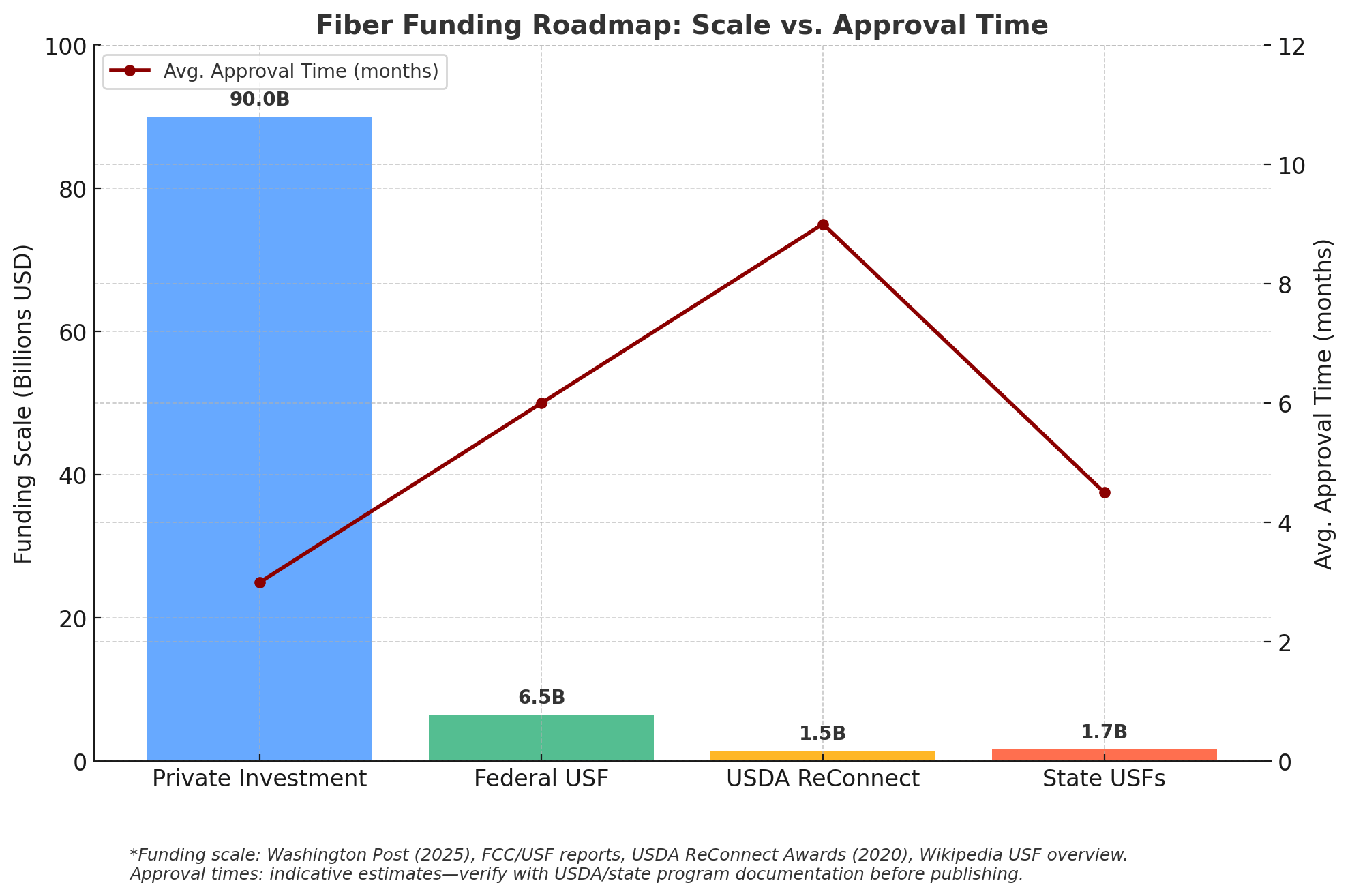
As shown below, private investment far exceeds public funding in total dollars. However, state USFs and local partnerships often approve projects faster than multi-year federal cycles. Knowing where each path fits is your first strategic advantage.
USDA ReConnect Program: Grants, Loans, and Hybrid Funding
One of the most dependable federal programs, USDA ReConnect offers grants, loans, and hybrid funding. So far, it's delivered $1.5B across 39 states - covering construction, electronics, labor, and more.
What to know:
Eligibility: Targets areas under 25/3 Mbps
Speed: ARRs can be cleared in days, though full approval takes longer
Pro tip: Detailed maps and demand data are must-haves for a successful application
State Universal Service Funds (USFs): The Fastest BEAD Alternative
Over 40 states operate USFs, distributing roughly $1.7B annually. Unlike BEAD, these programs often fund projects within 3-6 months.
Why this matters:
Local edge: Levels the playing field for regional ISPs against national incumbents
Flexible terms: Each state sets its own criteria, often prioritizing affordability and broadband plan alignment
Find available programs through your State Public Utility Commission directory.
Public-Private Partnerships (P3s) for Fiber Expansion
Local governments are bringing real dollars to the table. In 2022, over $10B in ARPA funding went to broadband projects via counties and municipalities.
For ISPs, this means:
Shared financial risk
Faster approvals than federal funding
Built-in community validation through pre-signups
Explore ARPA broadband funding guidance to connect with decision-makers in your area.
Other Federal Broadband Funding Opportunities
BEAD isn't the only federal game:
RDOF: $9B already awarded - visit the FCC RDOF page
Middle Mile Grant Program: $930M distributed in 2023 - details at the NTIA site
ReConnect (ongoing): Still open - apply at the USDA ReConnect portal
Across all programs, success depends on the same formula: precise mapping, verified demand, and audit-proof compliance.
Private Investment in Fiber Builds
Not every build needs public money. Private broadband investment exceeds $90B/year and often closes in weeks - not months.
What investors look for:
Repeatable build models
Clear ROI timelines
Operational excellence that reduces churn and costs
Tap into regional banks, infrastructure funds, and broadband investors via associations like the Fiber Broadband Association.
Why ISP Operations Are Just as Critical as Funding
Winning a grant or securing private capital is just the first step. Delivering on those dollars requires a high-performing operational backbone - and that's where Sonar Software leads.
Sonar: Your OSS/BSS Operational Advantage
Sonar offers a flexible, fiber-ready /BSS platform to help ISPs streamline delivery - whether funded by BEAD alternatives or private capital.
Adtran Mosaic CP: Seamless provisioning automation, reducing errors and installation time
VETRO FiberMap: GIS integration ensures accurate address mapping and phase alignment
CrowdFiber: Aggregates community demand inside your CRM, improving your proposal's appeal
Bottom Line
Missed out on BEAD? Your broadband build is far from dead. Alternatives like ReConnect, state USFs, local partnerships, and private capital offer viable paths to funding.
When paired with a platform like Sonar - and integrations from Adtran, VETRO, and CrowdFiber - you're equipped to build smarter, scale faster, and stay compliant from day one.
Explore new broadband funding opportunities with Adtran's Portal
Discover how Sonar Software powers expansion with automation and precision.
FAQ: What Operators Are Asking
Q1. What's the fastest alternative to BEAD funding?
State USFs often move within 3-6 months - faster than most federal programs.
Q2. How competitive is USDA ReConnect?
Highly competitive. Strong mapping and demand documentation are key.
Q3. How do local partnerships work?
They combine municipal funding with ISP expertise - over $10B in ARPA dollars were allocated this way in 2022.
Q4. What role does private capital play?
Private broadband funding tops $90B yearly and often closes faster than public options.
Q5. How does Sonar help meet funding requirements?
Sonar integrates provisioning, mapping, and demand tools to streamline grant compliance and boost operational efficiency.
Questions, answered.
What are the best alternatives to BEAD funding for fiber operators who missed out?
If a fiber operator did not qualify for BEAD, alternatives like USDA ReConnect, state Universal Service Funds, public-private partnerships, and private capital can still keep expansion plans viable. These paths let operators continue building without waiting on the next federal cycle.
What is the fastest funding alternative to BEAD for ISPs?
Private broadband investment is often the quickest option, since it exceeds $90B per year and frequently closes in weeks rather than months. State Universal Service Funds are another fast route, often funding projects within 3 to 6 months.
How does USDA ReConnect work for rural broadband builds?
USDA ReConnect targets areas under 25/3 Mbps and offers grants, loans, and hybrid funding. It has delivered $1.5B across 39 states to support rural broadband expansion.
Can public-private partnerships fund broadband expansion?
Yes. Over $10B in ARPA funding went to broadband projects through counties and municipalities in 2022 by way of public-private partnerships, giving operators another way to fund builds outside federal grant programs.
See it on the platform
20 minutes wired to your operation.
An ISP-only specialist walks Sonar through your specific use case. No generic deck, no horizontal SaaS pitch.
Book a meetingWritten by
Madeline HannaMarketing, Sonar
Madeline Hanna is Customer Marketing Manager at Sonar Software, writing about customer experience, retention, and broadband funding for ISP operators.
All posts by Madeline Hanna