
Operations
Inventory Management KPIs Every ISP Should Track
Key performance indicators (KPIs) in inventory management are metrics that help you monitor and make decisions about your stock.
August 9, 2022 · 5 MIN · UPD JUN 16, 2026
Inventory management KPIs are the metrics ISPs use to monitor stock and make decisions about it. They broadly fall into three categories - Sales, Operational, and Receiving KPIs - that together show how inventory moves through its lifecycle, from purchase order to deployment on your network.
In a previously created guide, we showcased how you can use Key Performance Indicators to track the overall effectiveness of your organization, focusing mostly on customer satisfaction and customer support statistics. While that is a very common interpretation of how KPIs can be applied to support your business, it’s far from the only way. To maximize organizational efficiency and service delivery, you should also consider monitoring how you manage inventory.
What is an inventory management KPI?
Like any other monitoring system, the specific Key Performance Indicators implemented by your organization will vary depending on how you manage your inventory. Fundamentally, the KPIs you’ll want to implement will enable you and your team to establish clear benchmarks for the items you’ve purchased, and will help to minimize future bottlenecks, whether in network growth or customer acquisition.
Inventory Management KPIs will broadly be split into 3 categories:
Sales KPIs
Operational KPIs
and Receiving KPIs
While each of these categories focuses on different stages of the acquisition process, they help capture an overall picture of how your inventory is moving through the various stages of its lifecycle.
Sales KPIs will serve to track the typical amount of inventory purchasing and inventory demand within a certain time frame. Think of the typical Sales KPI for inventory management as a way to track the cost and revenue derived from the acquisition or sale of your organization’s inventory.
Operational KPIs will serve to track the overall inventory behavior in your organization within a certain time frame. Operational KPIs are the ones that generally deal the most directly with efficiency, existing as a way to directly monitor inventory usage.
Lastly, Receiving KPIs will serve to track the overall incoming inventory handling, allowing you to closely monitor the inbound inventory items shipped to your warehouses. Implementing Receiving KPIs will facilitate the automation of inventory ordering and facility organization.
Choosing the right KPI metrics for your ISP
Now that you have a basic understanding of the KPI categories, it’s important to consider which ones apply best to your organization. Inventory upkeep can be a challenge for even the largest Internet Service Providers. This is due to the sheer amount of inventory flowing through warehouses, which is necessary to maintain network infrastructure, deploy new serviceable areas, and provide equipment to customers. Without implementing some way to measure inventory metrics, it’s possible to get lost in the weeds of ordering more and more inventory without having deployed a sufficient amount to recoup your expenditure.
Choosing the right KPIs for your inventory management is critical to implementing continuous improvements and for promoting continuous growth, and not all metrics will apply to every organization. Below, you’ll find some examples of common Inventory Management metrics, along with some equations to help you implement them.
Sales metrics:
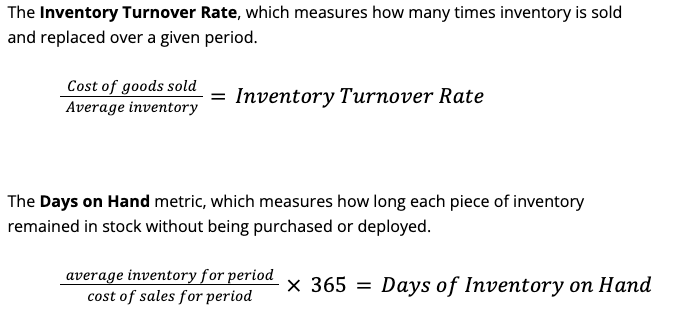
Similarly, there exists a “weeks on hand” metric, where the equation is multiplied by 52 rather than 365.
The Stock to Sales Ratio metric, which measures the percentage of items in stock that are being sold versus kept on hand.

The Backorder Rate metric, which identifies the number of backorders as a percentage of total orders in a given time period.

The Rate of Return metric, which measures the net loss or gain of your purchases within a specific time period.

The Product Sales metric, which measures the final revenue of all inventory sales after factoring in returns and discounts.

The Gross Margin by Product metric, which identifies the overall profit margin percentage based on the overall item sales your organization made in a given period.

Operational metrics:
The Inventory Shrinkage value, which measures the difference between initially counted inventory and final inventory counts within a time period.

The Average Inventory metric, which will show you the average amount of in-stock inventory within a time period.

The Inventory Carrying Costs metric, which measures the total cost of storing unsold or undeployed inventory.

The Fill rate, which measures the amount of orders (or jobs) you’re able to fulfill without running out of inventory.

The Order Cycle Time, which measures the amount of time it takes to fully fulfill an order.

Receiving metrics:
The Receiving Efficiency metric, which provides a quick way to measure the time between receiving items from a Purchase Order, and having them ready for sale or deployment on your network.

The Time to Receive metric, which will measure the overall time it takes to prepare a received item for sale or deployment, rather than the time between these activities.

The Supplier Quality Index metric, which is a way to measure the relative quality of items received from one of your suppliers.

Operational efficiency, financial health, and reputation depend on good business processes, including inventory management. These metrics, while not an exhaustive list, hopefully provide you with some ideas of ways you can implement inventory management systems in your organization. With Sonar Software, your inventory management module allows you to dynamically measure and extract relevant data. With the built-in Business Intelligence Reporting, you’ll be able to schedule in-depth reports that will contain the information needed to generate the KPIs you determine fit your business needs. For more information on how Sonar’s Inventory and Reporting modules can benefit your business, reach out to sales@sonar.software.
Frequently asked questions
What are the three categories of inventory management KPIs?
Inventory management KPIs broadly split into Sales KPIs, Operational KPIs, and Receiving KPIs. Sales KPIs track inventory demand, cost, and revenue; Operational KPIs track inventory usage and efficiency; and Receiving KPIs track how inbound inventory is handled once it reaches your warehouses.
Why do ISPs need to track inventory management KPIs?
Internet Service Providers move large volumes of inventory through their warehouses to maintain network infrastructure, deploy new serviceable areas, and provide equipment to customers. Without measuring inventory metrics, it’s easy to keep ordering more stock than you actually deploy, which prevents you from recouping that expenditure.
Questions, answered.
What is an inventory management KPI for an ISP?
An inventory management KPI is a metric that helps an ISP monitor its stock and make decisions about inventory across its lifecycle. These metrics let you track how equipment moves from when it arrives to when it gets deployed.
What are the main categories of inventory management KPIs?
Inventory management KPIs broadly fall into three categories: Sales KPIs, Operational KPIs, and Receiving KPIs. Sales KPIs track inventory demand, cost, and revenue, Operational KPIs track inventory usage and efficiency, and Receiving KPIs track inbound inventory handling.
Why is inventory tracking important for Internet Service Providers?
Without measuring inventory metrics, ISPs risk ordering more inventory than they actually deploy and then failing to recoup that expenditure. Tracking the right metrics helps you align what you purchase with what you put into service.
How should an ISP choose which inventory KPIs to track?
Choosing the right KPIs is critical to continuous improvement and growth, and not all metrics apply to every organization. Select the metrics that reflect how your business orders, deploys, and receives inventory rather than tracking everything by default.
See it on the platform
20 minutes wired to your operation.
An ISP-only specialist walks Sonar through your specific use case. No generic deck, no horizontal SaaS pitch.
Book a meeting