Industry insight
From 2G to 6G: The Evolution of Telecom Networks
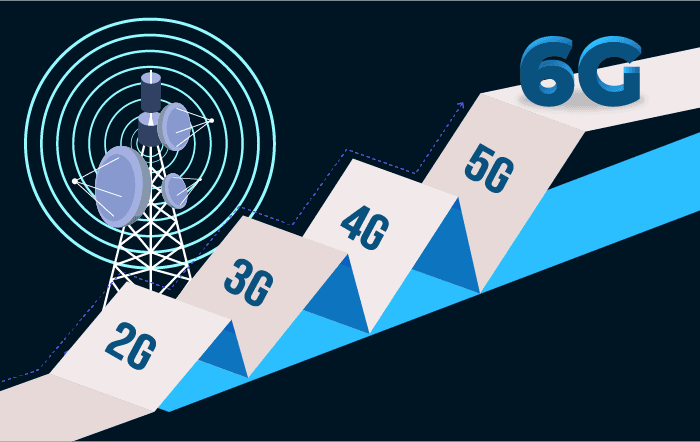
The evolution of telecom networks from 2G to 6G showcases the remarkable progress made in the realm of connectivity and communication
Taneil Currie, Former Senior Manager, Growth Marketing
June 11, 2023 · 3 MIN · UPD JUN 16, 2026
The evolution of telecom networks from 2G to 6G is the story of each mobile generation delivering major gains in speed, latency, and device connectivity. 2G introduced digital voice and text in the early 1990s, 3G unlocked mobile data, 4G powered the app economy, 5G now delivers up to 20 gigabits per second, and 6G aims for terabit speeds with near-zero latency.
Telecommunication networks have come a long way since the introduction of 2G (second-generation) networks. Over the years, each new generation has brought significant advancements, transforming how we connect and communicate. From 2G's humble beginnings to the upcoming era of 6G, let's embark on a fascinating journey through the evolution of telecom networks.
2G - The Digital Revolution
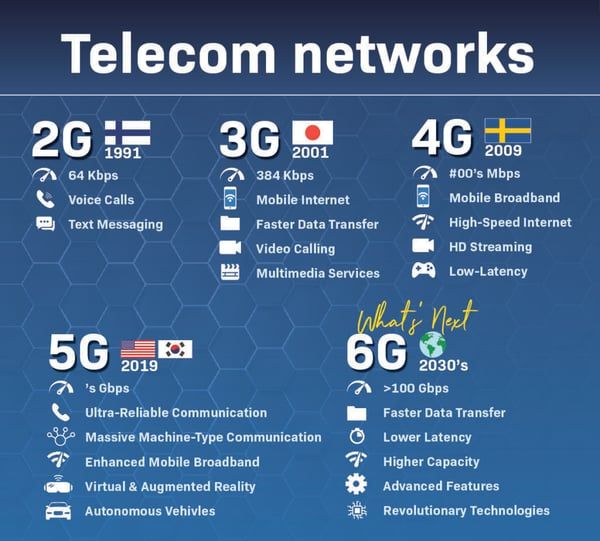
The arrival of 2G networks marked a turning point in mobile communication. Introduced in the early 1990s, 2G brought digital voice calls and text messaging, replacing the analog systems of its predecessor. It provided more efficient spectrum utilization, improved call quality, and expanded network capacity. Suddenly, communication became more accessible and affordable, laying the foundation for a mobile-centric future.
3G - The Era of Mobile Data
The world witnessed a significant leap forward with the advent of 3G networks in the early 2000s. This generation enabled high-speed data transmission, allowing us to access the internet, send emails, and enjoy multimedia content on our mobile devices. 3G revolutionized mobile browsing, paving the way for GPS navigation, mobile banking, and video streaming services. It was the stepping stone that transformed phones into indispensable pocket companions.
4G - The Age of Connectivity
The introduction of 4G networks brought about a true era of connectivity and mobile empowerment. Rolled out in the late 2000s, 4G provided even faster data speeds, reduced latency, and enhanced network stability. This revolution made high-definition video calling, mobile gaming, and streaming seamless experiences. The rise of social media platforms, online collaboration, and the app economy can largely be attributed to the widespread adoption of 4G.
5G - Empowering the Digital Future
Currently, we find ourselves in the midst of the 5G revolution. 5G networks, with their unparalleled speed, ultra-low latency, and massive device connectivity, are set to reshape our world. With download speeds reaching up to 20 gigabits per second, 5G will unlock many transformative technologies like autonomous vehicles, remote robotic surgery, and smart cities. It will fuel advancements in IoT (Internet of Things), AI (Artificial Intelligence), and virtual reality, transforming industries and enabling unimaginable innovations.
6G - Envisioning the Future
While 5G is still being deployed worldwide, the industry is already looking ahead to the potential of 6G. As technology continues to evolve, 6G aims to push the boundaries even further. With theoretical speeds of terabits per second, almost zero latency, and unparalleled reliability, 6G will revolutionize human-machine interactions. It promises to create a truly immersive and hyper-connected world where holographic communication, advanced AI integration, and ubiquitous connectivity will be the norm.
Final Thoughts
The evolution of telecom networks from 2G to 6G showcases the remarkable progress made in the realm of connectivity and communication. Each generation has paved the way for unprecedented advancements and transformed how we live, work, and interact. From the basic voice calls of 2G to the potential of 6G's futuristic applications, the journey of telecom networks highlights the incredible power of innovation and human imagination. As we eagerly await the dawn of 6G, let us embrace the possibilities it holds and the potential it offers for a more connected and dynamic future.
Frequently asked questions
What is the main difference between each generation of telecom networks?
Each generation builds on the last with faster data speeds, lower latency, and greater connectivity. 2G brought digital voice and text, 3G added mobile data, 4G enabled seamless streaming and the app economy, 5G introduced ultra-low latency and massive device connectivity, and 6G aims for terabit speeds.
How fast is 5G?
5G networks deliver download speeds reaching up to 20 gigabits per second, along with ultra-low latency and massive device connectivity that support technologies like autonomous vehicles, smart cities, and IoT.
What will 6G make possible?
With theoretical speeds of terabits per second, almost zero latency, and unparalleled reliability, 6G is expected to enable holographic communication, advanced AI integration, and ubiquitous connectivity.
Questions, answered.
What is the difference between 2G, 3G, 4G, and 5G networks?
Each generation brought major gains in speed, latency, and connectivity. 2G introduced digital voice calls and text messaging, 3G added high-speed mobile data and internet access, 4G delivered faster speeds and lower latency, and 5G provides download speeds up to 20 gigabits per second with ultra-low latency.
When did 2G networks first arrive?
2G arrived in the early 1990s. It replaced analog systems with digital voice calls and text messaging.
What did 3G and 4G networks add for mobile users?
3G launched in the early 2000s and enabled high-speed mobile data, internet access, and video streaming. 4G rolled out in the late 2000s with faster speeds and lower latency, which helped fuel the app economy and social media.
How fast is 5G compared to earlier mobile generations?
5G delivers download speeds up to 20 gigabits per second with ultra-low latency and massive device connectivity. This is a major step up from earlier generations, each of which improved speed and latency over the one before it.
See it on the platform
20 minutes wired to your operation.
An ISP-only specialist walks Sonar through your specific use case. No generic deck, no horizontal SaaS pitch.
Book a meeting