Industry insight
Big Telecom vs. Local ISPs: How Telecom M&A Impacts Competition
Learn how mergers and acquisitions in the telecom industry have both positive and negative consequences on the overall industry landscape
Taneil Currie, Former Senior Manager, Growth Marketing
November 2, 2023 · 4 MIN · UPD JUN 16, 2026
Telecom mergers and acquisitions reshape competition by expanding coverage and improving services, while also risking reduced choice, higher prices, and the loss of the community-focused service that local ISPs provide. The net effect on consumers depends heavily on how consolidation is balanced against market diversity.
The competition between Big Telecom companies and Local Internet Service Providers (ISPs) has entered a new phase with the surge in mergers and acquisitions (M&A) within the industry. Assessing the repercussions of this M&A activity on consumers and the overall industry landscape is of utmost importance. In this dynamic industry, we explore the impact of M&A on competition and the endeavor for a more diverse and consumer-centric digital world, especially considering the influence of government grant funding, which has played a pivotal role in driving the recent wave of consolidations
M&A in the telecom industry has both positive and negative consequences. The industry giants and smaller local providers are at the center of this transformation. While M&A can bring about expanded coverage and improved services, it also raises concerns about reduced competition and a potential loss of the personalized touch that local ISPs often provide. The choices consumers make can significantly influence the direction of the industry, encouraging providers to maintain or adopt consumer-friendly practices that prioritize their satisfaction and engagement.
The Telecom Landscape: Big Telecom vs. Local ISPs
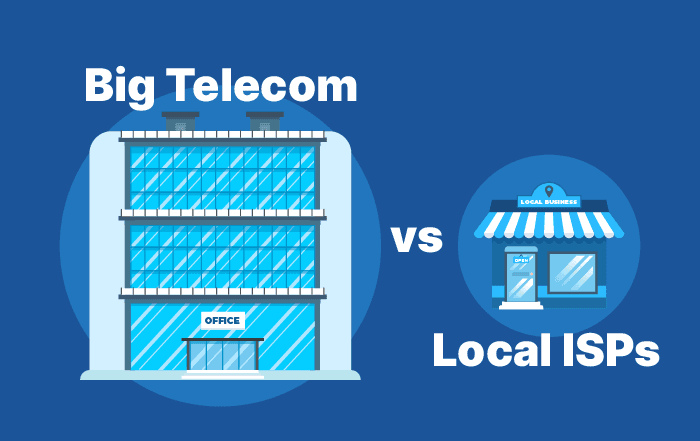
To begin, let’s gain a clearer understanding of the two sides of the telecom industry coin: Big Telecom and Local ISPs.
Big Telecom companies are the industry giants, such as AT&T, Verizon, and Comcast. They have the advantage of scale, a vast network infrastructure, and significant financial resources. Big Telecoms often offer bundled services, including internet, cable TV, and mobile plans, to attract a large customer base.
On the other hand, Local ISPs are the smaller, often community-based providers that cater to specific regions. These companies offer a personal touch, tailored services, and a strong connection to the local community. Local ISPs are often seen as more customer-focused and community-oriented than their larger counterparts.
Why Mergers and Acquisitions Happen in Telecom
Mergers and acquisitions (M&A) are a common strategy in the telecom industry. Big Telecoms often acquire smaller Local ISPs to expand their reach and customer base. While this strategy can have some benefits, it also raises concerns about the impact on competition.
The Positive Aspects of Telecom M&A
Expanded Coverage: M&A can help extend broadband access to underserved or rural areas, as Big Telecoms have the resources to invest in infrastructure development.
Improved Services: The consolidation of resources can lead to enhanced services, such as faster internet speeds, better customer support, and advanced technologies like 5G.
Economies of Scale: M&A can lead to cost savings, which may be passed on to consumers in the form of more competitive pricing.

The Negative Aspects of Telecom M&A
Reduced Competition: The most significant concern with M&A is the potential reduction in competition. Fewer providers mean fewer options for consumers, potentially leading to higher prices and lower service quality.
Loss of Local Touch: Local ISPs are known for their community-oriented approach, and M&A can result in the loss of this personal touch, leading to a disconnect between the provider and the community it serves.
How Consumer Choices Shape the Market
Consumers also play a crucial role in shaping the telecom landscape. By choosing service providers that align with their values, such as customer satisfaction and community engagement, consumers can encourage providers to maintain or adopt consumer-friendly practices.
Final Thoughts
The telecom industry is in a state of constant evolution, with M&A activity shaping the competition landscape. While there are potential benefits to mergers and acquisitions, such as expanded coverage and improved services, it’s essential to keep a close eye on their impact on competition and diversity in the industry.
As consumers, we have the power to support providers that align with our values. By making choices that prioritize customer satisfaction and community engagement, we can help shape a more diverse and consumer-friendly digital world where both big and small players in the telecom industry coexist harmoniously, providing the best services while respecting the preferences of consumers.
Frequently asked questions
Does telecom M&A help or hurt consumers? It can do both. Mergers can expand broadband coverage, improve services, and create economies of scale, but they can also reduce competition, raise prices, and erode the local touch that community ISPs provide.
Why are telecom mergers increasing now? Government grant funding has played a pivotal role in driving the recent wave of consolidations, encouraging providers to expand reach and infrastructure.
Can local ISPs still compete with Big Telecom? Yes. Local ISPs differentiate through tailored services, a personal touch, and strong community ties, and consumer choices that prioritize satisfaction and engagement can help them thrive.
Thinking about selling your ISP?, check out our blog Tips to Prepare Your Customers for a Merger or Acquisition
Questions, answered.
How do mergers and acquisitions affect competition between Big Telecom and local ISPs?
The biggest risk of telecom M&A is reduced competition, which can lead to fewer options, higher prices, and lower service quality. At the same time, consolidation can erode the community-oriented, personalized touch that local ISPs are known for.
What are the positive effects of telecom M&A for consumers?
M&A can expand broadband coverage to underserved and rural areas because Big Telecom has the resources to invest in infrastructure. Consolidation can also improve services through faster speeds, better support, and advanced technologies like 5G.
What are the risks of telecom consolidation for local ISPs and their communities?
Consolidation can reduce competition, which may result in fewer options, higher prices, and lower service quality for customers. It can also erode the community-oriented, personalized service that local ISPs are known for.
How has government grant funding influenced the recent wave of telecom M&A?
Government grant funding has played a pivotal role in driving the recent wave of telecom consolidation. These funds help support the infrastructure investment that fuels mergers and acquisitions across the industry.
See it on the platform
20 minutes wired to your operation.
An ISP-only specialist walks Sonar through your specific use case. No generic deck, no horizontal SaaS pitch.
Book a meeting