
Operations
Essential Field Service KPIs for ISP Dispatchers and Field Technicians
Tracking KPIs can help you drive profitability and lower costs, provide a better customer experience, and increase field technician performance.
June 10, 2022 · 6 MIN · UPD JUN 16, 2026
For Internet Service Providers, the most important field service KPIs fall into two areas: dispatcher metrics like time to schedule and travel time, and field technician metrics like first-time fix rate, job completion time, and repeat service calls. Tracking these indicators helps ISPs lower costs, reduce truck rolls, and improve both technician performance and customer satisfaction.
As an Internet Service Provider, it is essential to keep up with your company’s key performance indicators, also known as KPIs. KPIs help with assessing many key factors within your business, such as when you need to hire more staff, expand your coverage, or perhaps extend your support hours. KPIs are productive indicators for keeping track of your business productivity and all-around customer service satisfaction. Sonar Software offers the ability to track your company’s KPIs with Sonar BI, which provides detailed reports of your company’s data.
Which Field Service KPIs Matter Most?
Each company will have different KPIs that they feel are important to them. A couple of key areas to consider would be your Dispatchers, and your Field Technicians, or what some companies call their Field Operations Departments.
Dispatcher KPIs: Time to Schedule and Travel Time
Time to Schedule
For a dispatcher, the time it takes to get a job scheduled is very significant within the company. It impacts technicians’ productivity and customer satisfaction. The turnaround time from the first point of contact to the time a technician arrives is a high priority for companies who offer tiered contracts with timed agreements or service protection plans that guarantee a specific response time.
If a dispatcher allows jobs to pile up and productivity to lower, then the company would be impacted negatively. Making this a KPI is essential to ensuring your field operations are running smoothly and efficiently.
Travel Time
When a dispatcher is scheduling jobs, they have a few obstacles that should be on their minds. Such as, how long will it take the technician to drive to the appointment from their starting point? Where are the technician’s other scheduled jobs in relation to this one? Have you taken into consideration the travel time versus time to complete when scheduling the job? It is possible that a different technician who is closer can complete the job versus one who is further away.
The more your technicians are driving, the more wear and tear on their service vehicles, which results in required maintenance and downtime from billable hours. It also means an increase in gas consumption and, subsequently, an increase in cost.
Field Technician KPIs: First-Time Fix, Completion, and Repeat Calls
The great thing about partnering with Sonar is with our software, we have a Field Tech Mobile App that your technicians can utilize while in the field to improve the efficiency of their days. A few key features provided with our mobile app are the ability to check in to a job directly from their phone, add or move inventory through the app, as well as assist with contract signing.
First-Time Fix Rate
Tracking how often your technicians are resolving the problem the first time they are dispatched allows you the opportunity to evaluate your staff’s experience and whether more training is needed. It can also give insight into whether your technicians are going prepared for their jobs or not; if they are unable to complete a job due to a lack of hardware being available on their truck, then they perhaps didn’t review their jobs and stock their equipment before their workday began. It could also mean they possibly have a timing issue that is causing them to rush through their day without correct preparations. To get a high percentage First-time fix rate, some key aspects to look at would be: Are issues diagnosed properly before dispatch? Are you providing the technician with the experience necessary to complete the task with the correct resources and hardware?
This KPI is critical to customer satisfaction, building confidence within your team members, and keeping productivity high with appropriate utilization of company resources and revenue.
Job Completion Time
Do you know your company’s average time to complete certain tasks? Most companies do and set their jobs accordingly.
Knowledge of the work that goes into each job and how long it will take, as well as the travel time to get there, are key aspects of this KPI. This helps to keep your dispatchers from overbooking your technicians and driving down your customer satisfaction ratings. Furthermore, it identifies any billing calculation errors for the performed work.
Job Completion Success Rate
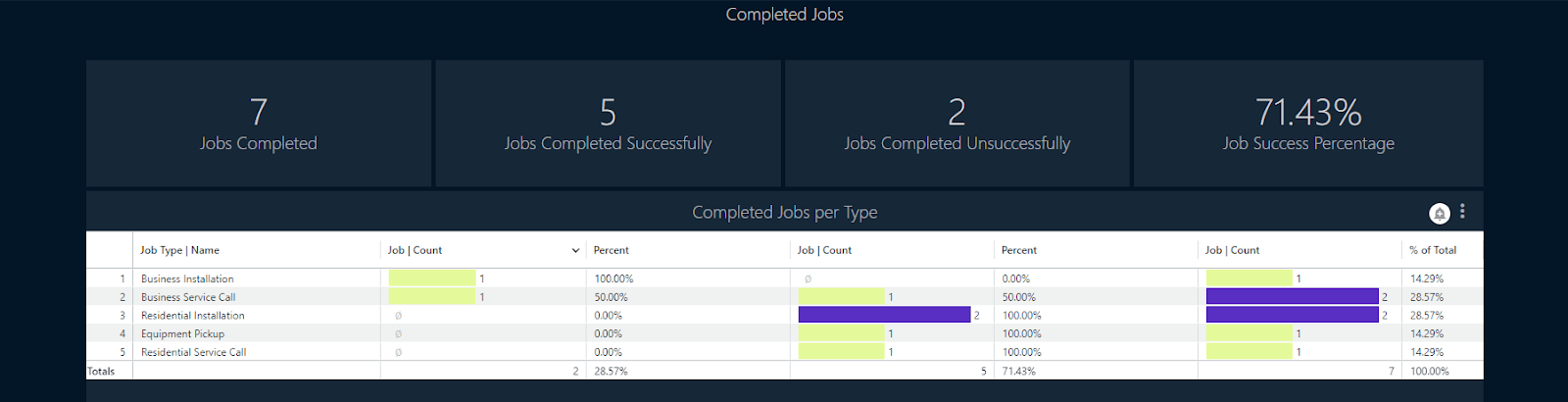
It’s great to know what percentage of your jobs are being completed at a success rate over a failure. Successful completions mean billable hours for most companies, whereas if a job fails it is likely cutting into your overhead costs and, once again, places more wear and tear on your resources than your company is profiting from.
Knowing your Job Completion Success Rate will help with possible troublesome areas within your company’s geographical location or network as well. For example, with a if your access points are not high enough or out of alignment on your tower and the Line of Sight (LoS) in the area is not reaching the intended destinations you provisioned your service for, your job success rate will be lower in that location due to installation failures.
Repeat Service Calls
Keeping this percentage to a minimum is key to customer satisfaction. Most customers want to avoid waiting for their service to be resolved over multiple trips. Knowing the percentage of total jobs that get repeated due to human error, network issues, or something just not working out the first time can cause major problems within your personnel’s confidence to resolve and your customer’s satisfaction with your service and company.
Other Field Operations KPIs Worth Tracking
Customer Retention
With marketing being such an expensive situation for most companies with ads, blogs, social media, referrals, and offering discounts, customer retention is important for numerous companies. If you keep your current customers happy and satisfied with your service, then they continue to come back and do the marketing for you, with referrals.
Listening to their ratings of your company can help identify areas of weakness and where you may have opportunities to improve your operations.
Frequently Asked Questions
What is first-time fix rate for an ISP?
First-time fix rate measures how often a field technician resolves a customer’s problem on the first dispatch. A low rate can signal gaps in diagnosis before dispatch, technician training, or whether trucks are stocked with the right hardware before the workday begins.
Why does travel time matter as a field service KPI?
The more your technicians drive, the more wear and tear on their service vehicles, which means maintenance, downtime from billable hours, and higher gas costs. Factoring travel time into scheduling, and assigning the closest available technician, helps control those costs.
How can ISPs track these field service KPIs?
Sonar Software lets ISPs track company KPIs with Sonar BI for detailed reporting, while the Field Tech Mobile App helps technicians check in to jobs, manage inventory, and assist with contract signing directly from the field.
Questions, answered.
What field service KPIs should ISP dispatchers and field technicians track?
The most important field service KPIs fall into two areas. Dispatcher metrics include time to schedule and travel time, while field technician metrics include first-time fix rate, job completion time, and repeat service calls.
Why is first-time fix rate important for an ISP's field operations?
First-time fix rate measures how often a technician resolves an issue on the first dispatch. A low rate signals gaps in diagnosis, training, or truck-stocking before the workday begins.
How does travel time affect ISP field technician productivity?
More technician driving means more vehicle wear, maintenance downtime from billable hours, and higher fuel costs. For that reason, travel time should factor into every scheduling decision.
What lowers job completion success rate for a WISP?
For a WISP, misaligned access points or poor line of sight can drive down job completion success rate. These conditions lead to installation failures in that location.
See it on the platform
20 minutes wired to your operation.
An ISP-only specialist walks Sonar through your specific use case. No generic deck, no horizontal SaaS pitch.
Book a meeting